Flues & chimney liners
How we size, fit and certify stainless steel liners and twin-wall flues.
Liners & flues Over 35yrs trusted service
Carl Finnell · Case study · Harrogate, York & Mansfield
Some properties simply cannot be worked on from a ladder. Here is how we line exceptionally tall chimney stacks safely, using boom lifts and full scaffolding, on jobs from Harrogate and York to a period house in Nottinghamshire.
The problem
Most chimneys are straightforward to work on. A ladder, a roof ladder and the right harness will get an engineer safely to the pot, and the liner goes in from there. But some properties present a different problem altogether: exceptionally tall buildings, imposing stacks set high above a steep roof, or a stack that sits where no ladder can be footed safely.
At that point there are only two honest answers. Either you bring in the right access equipment, or you do not do the job. There is no version of this where someone stretches from a ladder and hopes. Working at height is where this trade hurts people, and a chimney liner is not worth an injury.
The solution
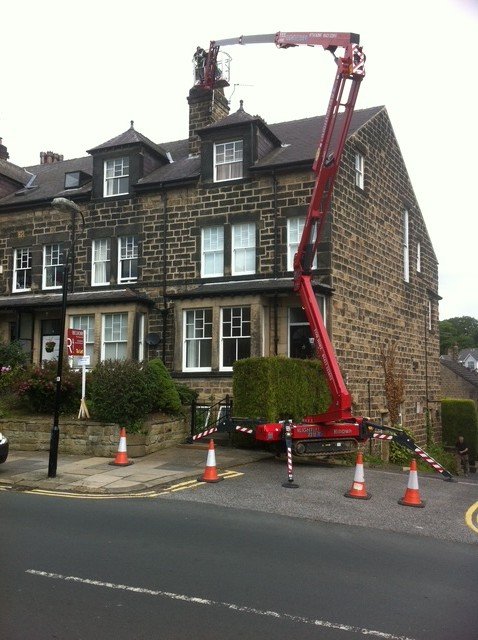
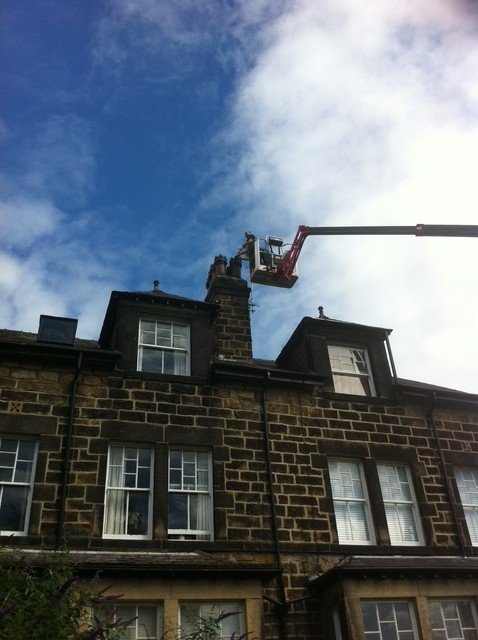
Which method we use depends on the height of the stack, the access around the building and the ground the equipment has to stand on. A man-operated boom lift, properly called a MEWP, is often the quicker option where there is firm, level ground and a clear approach. It puts the engineer alongside the pot with a stable working platform and no reliance on the roof itself.
Where the height is greater, the ground will not take a machine, or the job needs several days of work at the top, professionally erected scaffolding is the better answer. It costs more and takes longer to set up, but it gives a proper working deck and lets more than one trade work at height at once.
Either way the access is planned before the job is booked, not discovered on the morning. That is part of what a survey is for, and it is why we would rather look at an awkward property in person than quote it blind. You can see how we work on our installation page.
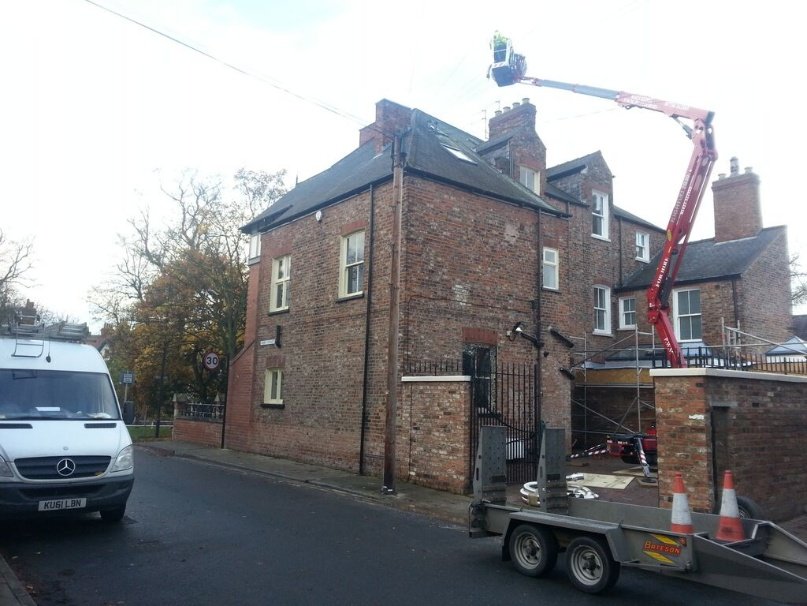
Harrogate and York
The Harrogate and York jobs shown above are both chimney liner installations on stacks too tall for conventional access. The work itself is what we do every week: a stainless steel liner sized to the appliance, an anti-downdraught cowl where the stack needs one, and any damaged flaunching made good while we are up there.
What changed was how we got to it. Once the access is right, the installation is the same careful job it would be on a bungalow. See our local guidance for chimney lining in Harrogate and chimney lining in York.
Cuckney House
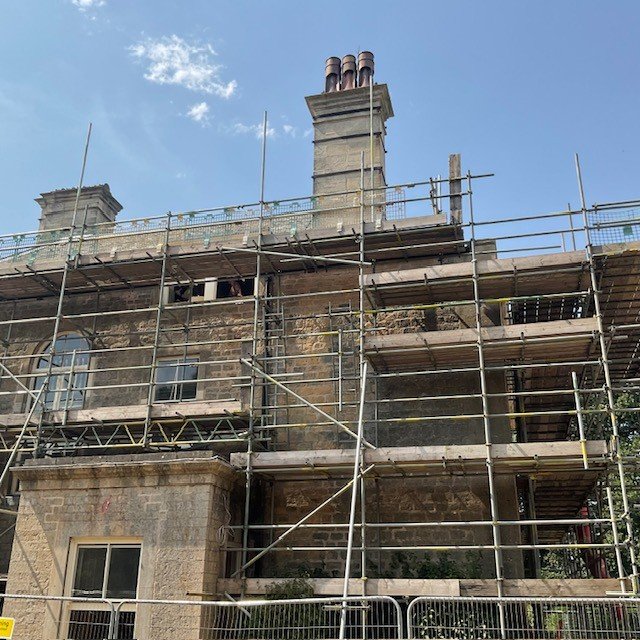
Cuckney House in Mansfield, Nottinghamshire, was the largest job of the three. We installed several fireplaces and wood burning stoves throughout the property, and the exceptional height of the chimney stacks made safe access impossible without specialist equipment.
Full scaffolding was erected to give secure access for our engineers to fit the stainless steel flue liners, chimney cowls and associated components. A project on that scale needs three things together: careful planning, the correct access equipment and experienced tradespeople. It is the kind of property we have been asked to work on for more than 35 years, and it is a fair distance outside our usual Yorkshire patch, which tells you something about how these jobs come to us.
The cost question
Access equipment costs money. A boom lift is a day rate, scaffolding is a hire plus an erect and dismantle charge, and on a tall stack that can be a meaningful part of the job. We would rather put that in front of you at survey than bury it, because it is the single most common reason a chimney quote comes in higher than someone expected.
It is also the reason a quote given over the phone for a tall property is close to worthless. Until someone has looked at the height of the stack, the state of the ground and the route in, nobody can tell you what the access will cost. An honest survey is cheaper than a surprise.
While we are up there
If a machine or a scaffold is going up, it makes sense to deal with everything at the top in one visit. Alongside the stainless steel liner we will fit an anti-downdraught cowl where the stack needs one, repair damaged flaunching, and check the pot, the brickwork and the pointing while there is safe access to them.
Doing that in one go is far cheaper than paying for access twice. It is worth asking about even if the original reason for the visit was only the liner. More on the work itself on our flues and chimney liners page.
Questions about this kind of job
We use specialist access equipment instead: either a man-operated boom lift, known as a MEWP, or professionally erected scaffolding. Which one depends on the height, the ground conditions and the access around the building, and it is decided at survey rather than on the day.
A mobile elevating work platform, commonly called a boom lift or cherry picker. It lifts the engineer alongside the chimney pot on a stable platform without relying on the roof for support, and it is often quicker than scaffolding where the ground is firm and level.
If the stack cannot be reached safely without it, yes, and it can be a significant part of the total. We always identify it at survey and price it separately so you can see exactly what the access is costing rather than finding it buried in the job.
On most properties, yes. Standard chimneys are lined using ladder and roof ladder access with the correct safety equipment. Scaffolding or a boom lift is only brought in where the height, roof pitch or ground conditions make conventional access unsafe.
Our regular patch runs from Leeds out to the coast, but larger multi-fireplace projects do take us further afield, as with Cuckney House in Nottinghamshire. For work outside the usual area it is worth asking rather than assuming.
Yes, and it is worth doing. Flaunching is the mortar weathering around the pot, and once safe access is in place it is far cheaper to repair it in the same visit than to arrange access again later.

HETAS Registration Number 2087
HETAS registered
Carl self-certifies every installation and notifies Building Control on your behalf, so the work is signed off properly and your certificate of compliance is issued for your records.
Explore
How we size, fit and certify stainless steel liners and twin-wall flues.
Liners & fluesStove and fireplace work across Harrogate and the surrounding villages.
Harrogate areaYour enquiry
Our home survey expert will review your details and email you about the next steps.
HETAS-registered installs. We cover Leeds, Harrogate, Wetherby, York, Ripon, Malton, Thirsk and Scarborough.
Not ready for a survey? Call or email us →