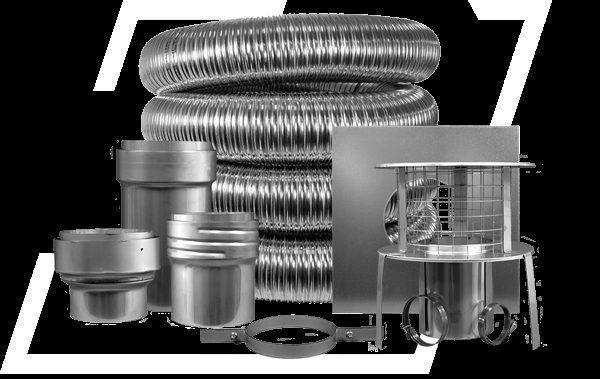
Carl Finnell fits chimney liners and twin-wall flue systems for stove installations across Wetherby and the surrounding Wharfe villages. This page focuses on the flue: when an existing chimney needs lining, how 316 and 904 grades are chosen, what relining involves and when a home without a usable chimney needs twin-wall instead.
The Wetherby area page explains the wider local service; this is the technical companion for the chimney. Georgian market-town homes, magnesian limestone cottages, riverside houses, racecourse-side properties and newer executive homes all ask different flue questions.
Process
How we specify a Wetherby chimney liner
The liner is specified after inspection, not from a town name. Chimney height, route, condition, appliance choice and use pattern all matter.
01Inspect the chimney and access
The survey checks the fireplace opening, chimney height, route, pot, access, signs of tar or damp, previous appliance history and whether the flue has been altered. Solid old chimneys can still be oversized or rough internally for a modern stove.
02Choose liner size and grade
The liner diameter follows the stove and manufacturer requirements. A 316 stainless liner is the common choice for many wood-burning installations. A 904 liner may be worth discussing where the stove will work hard, the chimney is exposed or smokeless fuel may be used.
03Fit the liner and terminal
The liner is installed through the chimney, connected to the stove pipe, secured at the top and finished with the right cowl or terminal. In conservation areas, the visible terminal choice needs the same care as the technical connection.
04Test, commission and certify
Once connected, the system is smoke-tested and commissioned. Where the liner is part of a HETAS stove installation, the notification and certificate are handled with the completed job.
Wetherby specifics
Lining Wetherby chimneys properly
Older Wetherby and Boston Spa chimneys were often built for open fires. That means they can be too large, cool or rough internally for a modern closed appliance. A correctly sized liner gives the stove a warmer, smoother, sweepable flue and helps it draw consistently.
Magnesian limestone and older masonry can make the visible fireplace feel substantial, but the inside of the chimney still needs checking. Failed parging, old soot, awkward offsets or a previous appliance history can all change the liner specification. The survey is where those issues are found.
Bramham, Collingham, Linton, Clifford, Thorp Arch, Walton and Spofforth include period houses, cottages, renovations and exposed village settings. If a stove is expected to work daily through winter, liner grade and terminal choice deserve more thought than an occasional-use room.
Where there is no usable chimney, a twin-wall insulated flue can be designed internally or externally if the route works. In Wetherby, Boston Spa and Bramham conservation settings, the visual route, brackets, terminal and roofline need careful judgement before a quote is agreed.