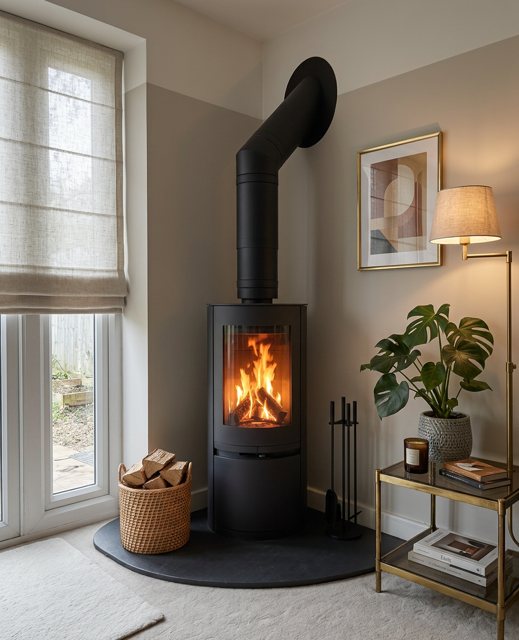
Carl Finnell fits fireplaces across Wetherby, Boston Spa, Bramham, Collingham, Linton, Clifford, Thorp Arch, Walton and Spofforth. The work often includes more than a surround: opening up, checking the chimney, forming the chamber, cutting the hearth, fitting a beam or surround and making the finished fireplace sit naturally in the room.
This page focuses on fireplace installation in Wetherby. The parent fireplace page covers the range; the Wetherby hub covers the town and villages. Here the detail is the practical fireplace work: period openings, limestone and stone-built rooms, conservation-area sensitivity, bespoke hearths, stove-ready chambers and high-spec renovation finishes.
Process
How a Wetherby fireplace is planned
The best Wetherby fireplace work starts with proportion. The material, opening size, hearth line and stove or fire all have to feel settled together.
01Assess the opening and chimney breast
The survey checks the existing fireplace, lintel, hearth, chimney route, wall finish and any previous alterations. Older Wetherby fireplaces may have been narrowed, boarded or adapted, so the safe structure behind the room finish matters.
02Choose materials in context
Oak, natural stone, limestone, slate, granite, brick and porcelain all give a different result. In Wetherby and Boston Spa, the pale limestone setting often rewards natural materials and restrained detailing rather than a fireplace that looks imported from another house.
03Build the chamber and hearth
Where a stove is included, the chamber, clearances and hearth dimensions have to suit the appliance and Building Regulations. Where the brief is fireplace-only, the structure still has to be permanent, level and proportionate.
04Finish and make good
The final plastering, edge details, hearth fit and beam height decide whether the job feels finished. If a stove is part of the fireplace, the flue and HETAS sign-off are handled as part of the same installation.
Wetherby specifics
Wetherby fireplace work by property type
Wetherby conservation-area properties and Georgian market-town rooms often have fireplaces that are part of the house character. A cast detail, old opening, stone wall or timber surround can be worth retaining if it is safe and suitable. The survey decides what can be kept, what needs rebuilding and what needs making good.
Magnesian limestone is a strong visual cue around Wetherby. That does not mean every fireplace has to be limestone, but the hearth, beam and chamber need to sit comfortably with pale stone, older plaster, timber floors and the scale of the room. A standard surround can look wrong if the proportions are not measured.
Boston Spa and Bramham bring the same conservation-area caution. Internal fireplace work is usually the main job, but a stove-ready fireplace may also raise questions about the liner, cowl or visible terminal. We flag those early so the finished fireplace is not compromised by a late flue decision.
The Wetherby Poppy case study is a good example of practical fireplace thinking. The important detail is not just the stove; it is the shaped granite hearth and the way the corner installation gives the room a focal point without losing a whole wall. That is the kind of decision that separates a fitted fireplace from a designed one.