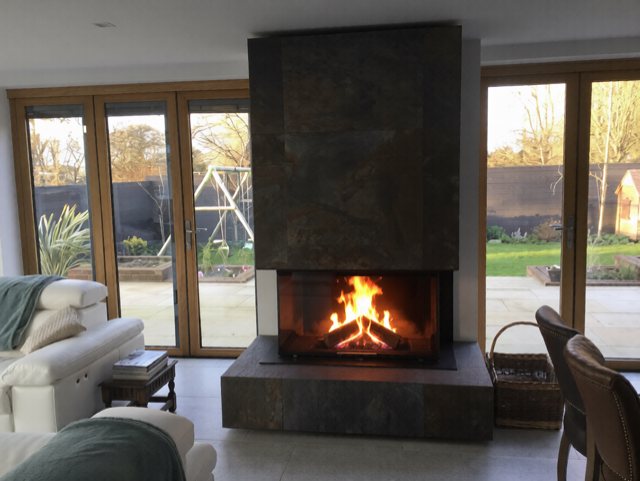
Carl Finnell fits fireplaces across York where the opening, surround, chamber, hearth and flue all have to work together. In Georgian and Victorian properties, the brief is often to keep or restore the character that is already there. In renovated homes, the job may be a more contemporary feature fireplace, but it still has to be built around the room rather than dropped in as a product.
This page focuses on fireplace installation in York rather than the whole service area. The parent fireplace page explains the range; the York hub explains the local patch. Here the detail is the actual fireplace work: opening up, hearths, chambers, beams, listed-building sensitivity and how the fire becomes part of the finished room.
Process
How a York fireplace is built properly
York fireplace work rewards restraint. The most successful jobs are the ones where the surround, hearth and chamber fit the age and scale of the building.
01Assess the opening and existing features
The survey checks the chimney breast, opening, lintel, hearth, flue route and any original surround or cast-iron feature. Where there is something worth keeping, the design starts there rather than replacing character by default.
02Choose a sympathetic fireplace finish
Oak, stone, brick, porcelain, slate and granite can all work in York, but the choice depends on the house. A Bishophill townhouse, a Fulford family room and a Nether Poppleton village home do not all want the same surround.
03Form the chamber and hearth
If a stove is included, the chamber, appliance clearances and hearth dimensions have to suit Building Regulations and the stove manufacturer instructions. If it is fireplace-only, the structure still needs to look permanent and proportionate.
04Make good and finish cleanly
The last stage is the part people notice: plaster edges, hearth line, beam height, trim and the way the fireplace meets the wall. Where a stove is fitted, the flue and HETAS sign-off sit within the same project.
York specifics
York fireplace work by property type
Georgian and Victorian homes around Bootham, Clifton, Fulford and Bishophill often have fireplaces that deserve careful handling. A cast-iron insert, timber surround or original opening can be part of the value of the room, so the question is not simply what new fireplace can be bought. It is what can be kept, made safe and framed properly.
Central York conservation areas and listed buildings call for particular caution. Internal fireplace work may still need listed-building consent if it affects protected fabric, and visible external flue or terminal changes should be considered before the route is chosen. We keep the wording honest on the survey: we can advise from experience, but we do not replace the council consent process.
Terraces inside and outside the walls often need more building work than the finished photograph suggests. Old openings may have been narrowed, boarded or adapted for previous appliances. A proper fireplace installation can include opening up, fitting a lintel, forming a stove chamber, cutting a hearth, lining the chimney and making good the wall.
The Spartherm Linear Triple case study shows the other side of York fireplace work: a contemporary feature fireplace with a bespoke porcelain wall. That kind of project is less about restoring an old opening and more about planning the fire, wall finish and room proportions so the feature looks designed, not added late.