Carl Finnell fits fireplaces across Harrogate where the finish matters as much as the appliance. In many homes the job is not simply choosing a surround; it is opening or restoring the fireplace, checking the chimney, forming a chamber, cutting the hearth and making sure the stove, beam or surround belongs to the room.
This page is the Harrogate-specific fireplace guide. It sits below the main fireplace page and beside the Harrogate area hub, but it focuses on the practical decisions: period openings, conservation sensitivity, material choices, hearth size, chamber finishes and the building work behind a finished focal point.
Process
How a Harrogate fireplace is planned
Harrogate homes often have fireplaces that are worth treating carefully. The survey is about finding out what can be kept, what needs rebuilding and what will look right once the room is finished.
01Assess the existing fireplace
We look at the surround, opening, chimney breast, hearth, lintel, flue route and any previous alterations. Period fireplaces may have been narrowed, covered or adapted, and the survey establishes what is safe and worth retaining.
02Choose materials in the room
Oak, natural stone, limestone, granite, brick and porcelain all behave differently in Harrogate light and against older plaster or stone. Samples at the home are more useful than showroom guesses, especially in larger period rooms.
03Build the chamber and hearth
Where a stove is included, the chamber, clearances and hearth dimensions have to work with the appliance and Building Regulations. Where the brief is fireplace-only, the structure still has to look proportionate and permanent.
04Make good to a finished standard
The final plastering, edges, beam height and hearth line decide whether the job feels built in. If the fireplace includes a stove, the flue and HETAS sign-off are handled as part of the same project.
Harrogate specifics
Harrogate fireplace work by property type
Victorian and Edwardian spa-town houses around the Stray, Duchy estate and Harlow Hill often have rooms large enough for a more formal fireplace. The risk is overdoing it. A surround or beam has to match the scale of the room without overwhelming the proportions, and the hearth has to protect the floor while still looking elegant.
Central Harrogate has several conservation areas, so sympathetic treatment matters. Most of the work is inside the home, but the design still needs to respect the building: period surrounds retained where they make sense, replacement materials chosen carefully, and any external flue or terminal question flagged before assumptions are made.
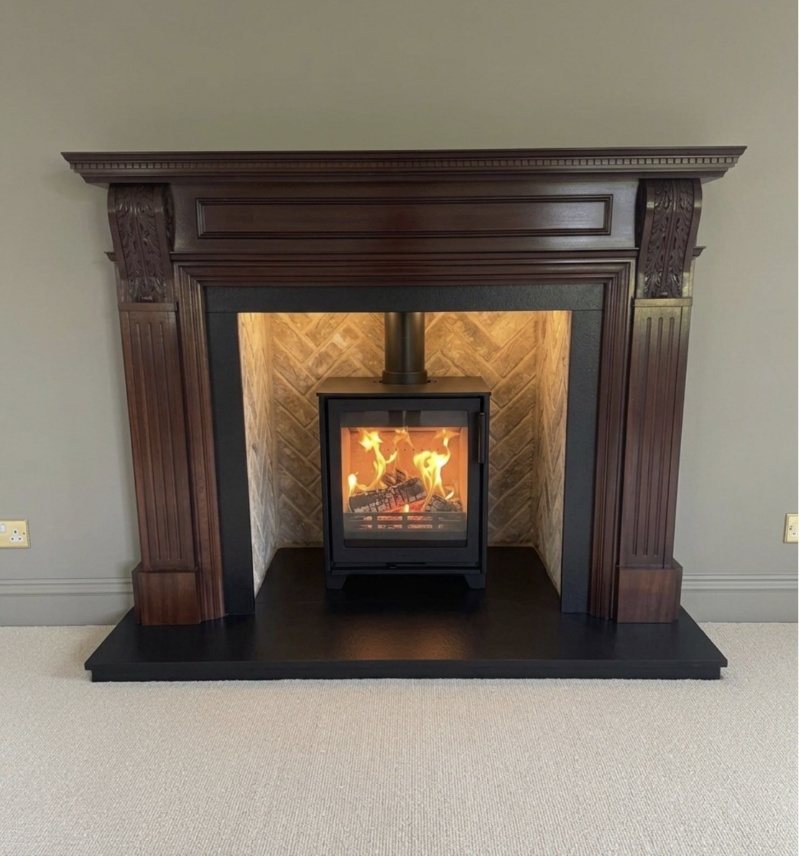
The Pannal case study shows the kind of Harrogate-district fireplace that needs judgement: a Contura 210 stove, herringbone chamber, Antique Leather granite hearth and restored mahogany surround. None of those parts works alone; the fireplace succeeds because they are balanced together.
In Beckwithshaw, Killinghall, Burn Bridge and the villages around Harrogate, stone homes and renovation projects often want a fireplace that feels as if it has always been there. That usually means a correct chimney liner, a chamber with texture, a hearth cut to the room and a finish that avoids showroom gloss.